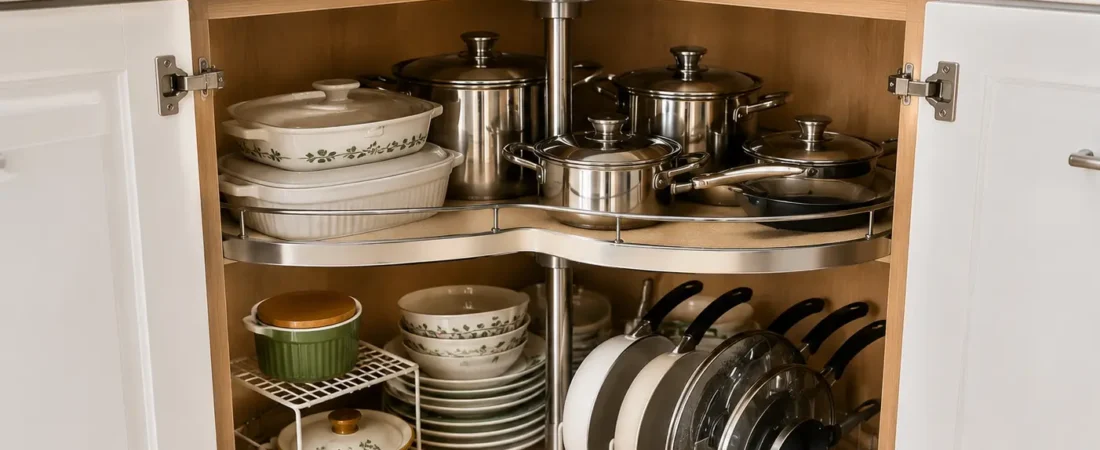
Kitchen corners have a reputation for being the place where useful things disappear. Pots get shoved into the back, containers become impossible to reach, and perfectly good storage space sits untouched.
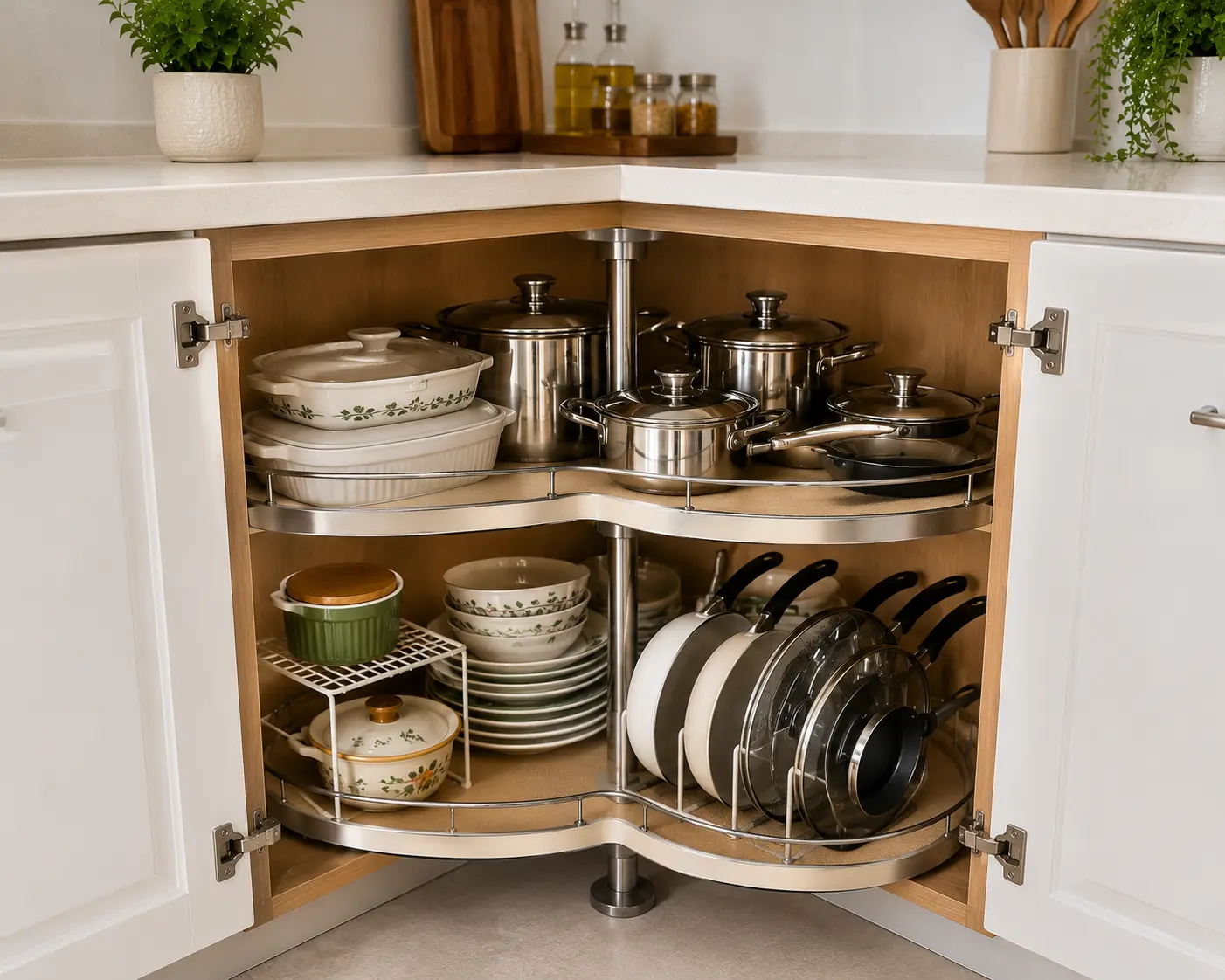
The good news is that you do not need a huge kitchen or a complicated renovation to fix it. With the right corner cabinet organization ideas, you can make awkward corners easier to access, easier to clean, and much more useful.
The key is to stop treating every corner cabinet the same. The best setup depends on the cabinet style, how deep it is, and what you actually need to store there. Here are practical ways to make even the most frustrating kitchen corner work better.
Why Corner Cabinets Are So Hard to Organize
Corner cabinets are awkward because they are often deep, dark, and difficult to reach. The farther an item sits toward the back, the more likely it is to be forgotten.
Another problem is visibility. In a normal cabinet, you can usually see most of the shelf at a glance. Corner cabinets often have hidden areas where small items disappear behind larger ones.
Depth can also encourage overstuffing. Because there appears to be plenty of room, it is tempting to keep adding cookware, serving dishes, containers, and appliances until the cabinet becomes difficult to use.
A good organizing system should solve three problems:
- Make stored items easy to see
- Make frequently used items easy to reach
- Prevent unused space from becoming a dumping zone
Once you know what type of corner cabinet you have, choosing the right solution becomes much easier.
Types of Corner Cabinets
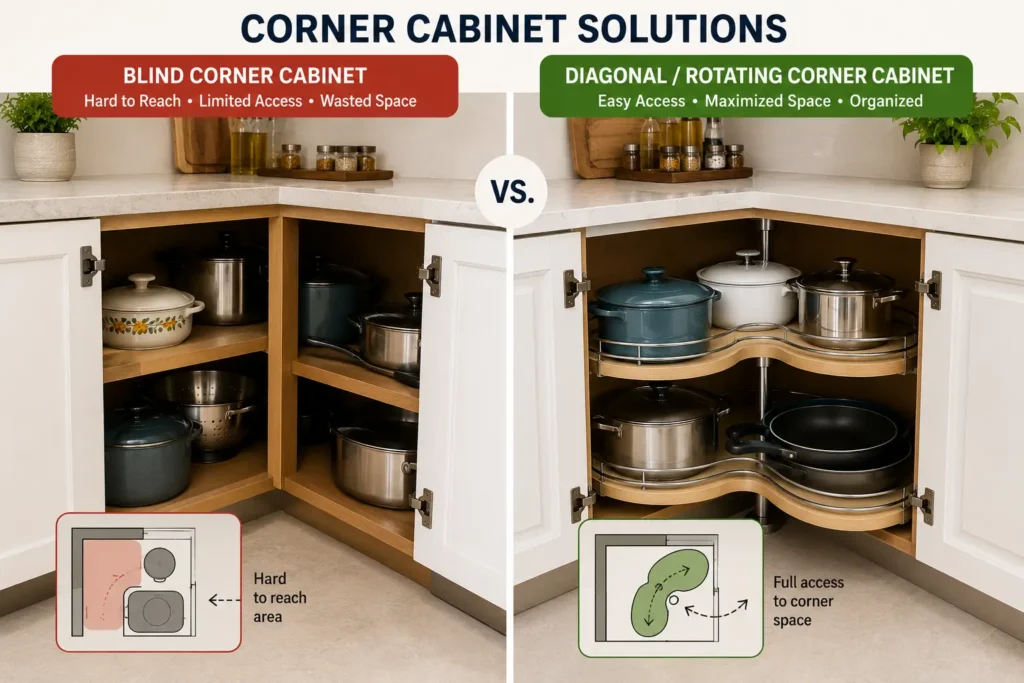
Before changing anything, take a look at the shape and opening of your cabinet. There are two common styles, and they work differently.
Blind Corner Cabinets
A blind corner cabinet has one opening, while part of the cabinet extends into the adjoining corner. This creates a deep hidden section that can be surprisingly difficult to access.
For these cabinets, blind corner cabinet solutions are especially useful when they improve visibility and bring items closer to the opening.
Lazy Susan or Diagonal Corner Cabinets
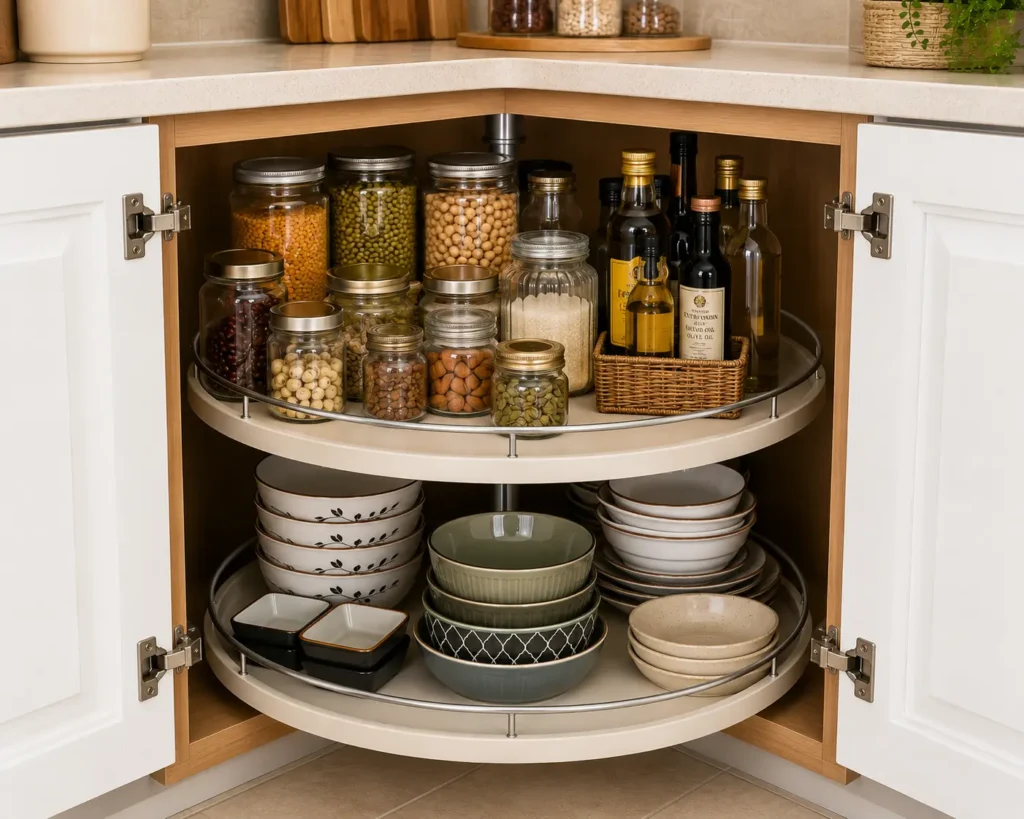
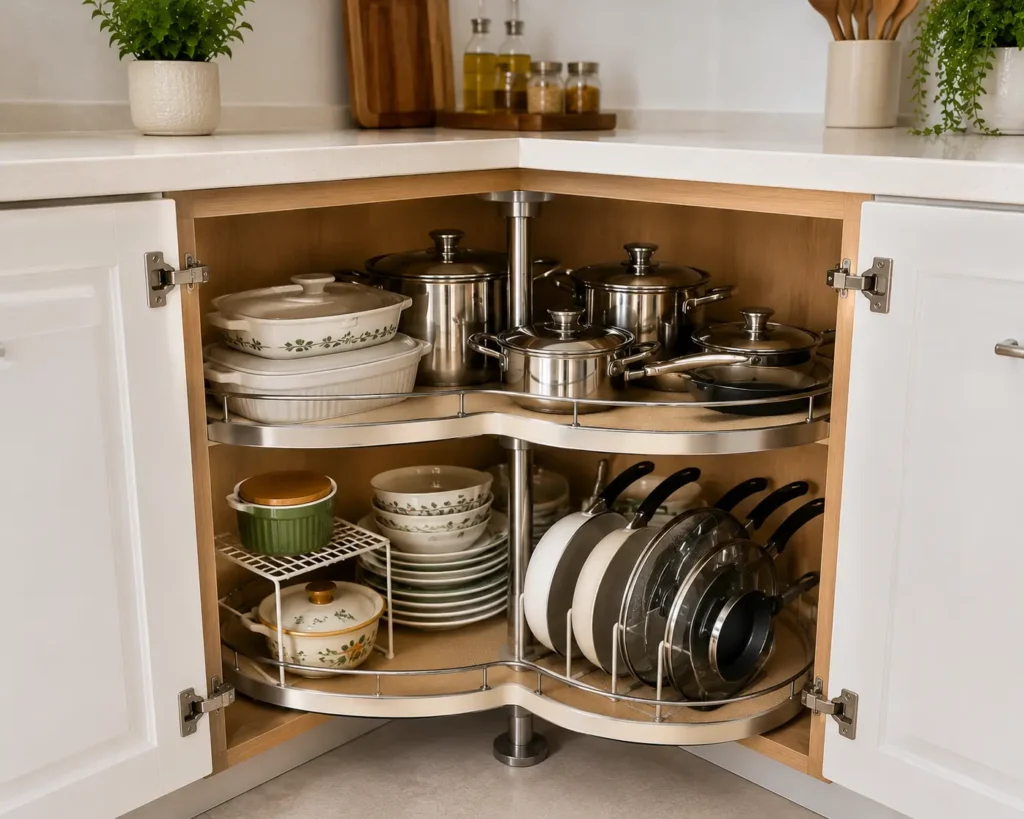
These cabinets are usually designed around a corner with an angled or diagonal front. They often have rotating shelves, making them easier to access than a blind corner.
A rotating shelf can work very well, especially when you organize items by category rather than piling everything together.
Knowing whether you have a blind corner or rotating-style cabinet helps you decide how to organize corner kitchen cabinets without wasting time on a setup that does not fit the space.
Best Corner Cabinet Organization Ideas
The smartest corner cabinet organization ideas are not about fitting the most items inside. They are about making every stored item easier to find and use.
Idea 1 – Lazy Susans and Turntables
A rotating shelf is one of the simplest ways to improve access in a corner cabinet. Instead of reaching into the back, you can turn the shelf and bring what you need toward you.
These work especially well for:
- Sauces and bottles
- Spices and cooking ingredients
- Small bowls
- Frequently used serving pieces
- Cleaning supplies stored safely away from food
Group similar items together rather than mixing everything. For example, keep cooking oils and sauces in one section and smaller pantry ingredients in another.
Turntables are also among the most practical lazy susan alternatives when you want a simple rotating solution without changing the entire cabinet.
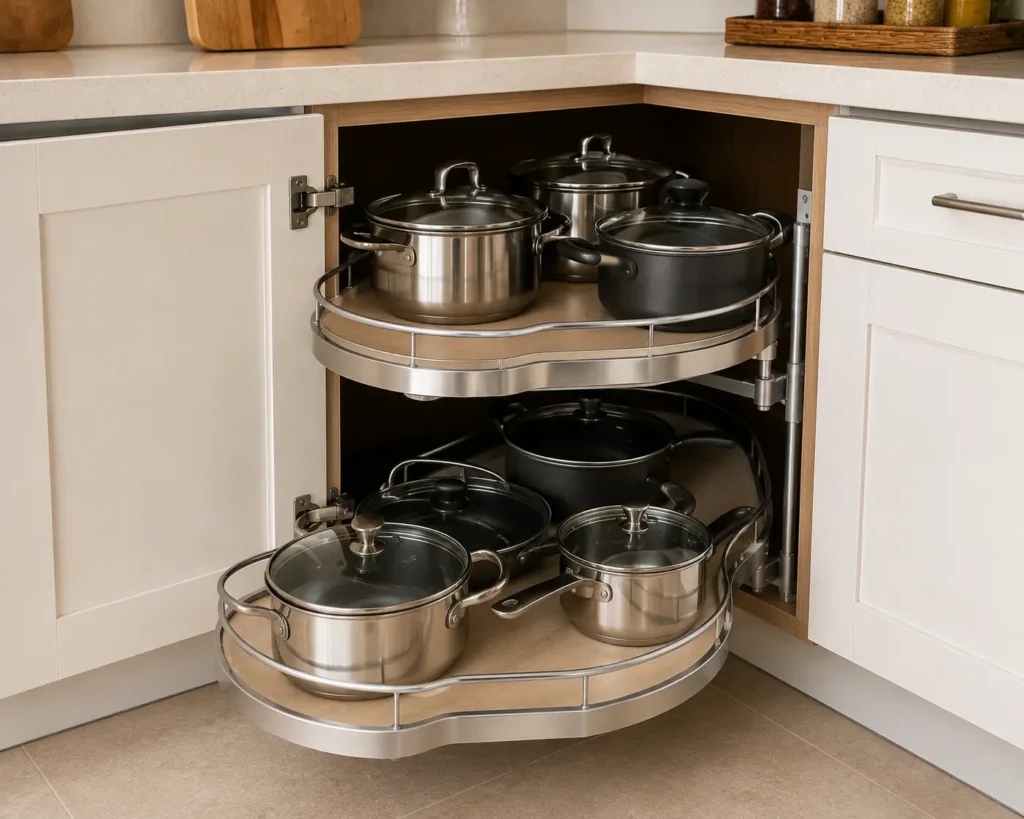
Idea 2 – Pull-Out Corner Shelving Systems
For a cabinet that is deep enough to hide everything behind the front row, pull-out corner cabinet shelves can make a major difference.
Instead of crawling halfway into the cabinet to reach something, the storage surface comes forward. This is particularly useful for heavier cookware and items that are used regularly.
A pull-out design can also make cleaning easier because you can see more of the cabinet floor and back wall.
The biggest advantage is accessibility. Storage only counts as useful if you can actually reach what is stored there.
Idea 3 – Use the Corner for Bulky, Rarely-Used Items
Not every cabinet needs to hold your everyday essentials. Deep corners are often better suited to bulky items that you use occasionally.
Think about items such as:
- Large serving platters
- Extra cookware
- Seasonal baking equipment
- Special-occasion dishes
- Large stockpots
- Entertaining supplies
This is a simple approach to deep corner cabinet organization because you are working with the cabinet’s natural depth instead of fighting it.
Keep the least-used items toward the back and the more frequently used bulky items closer to the front.
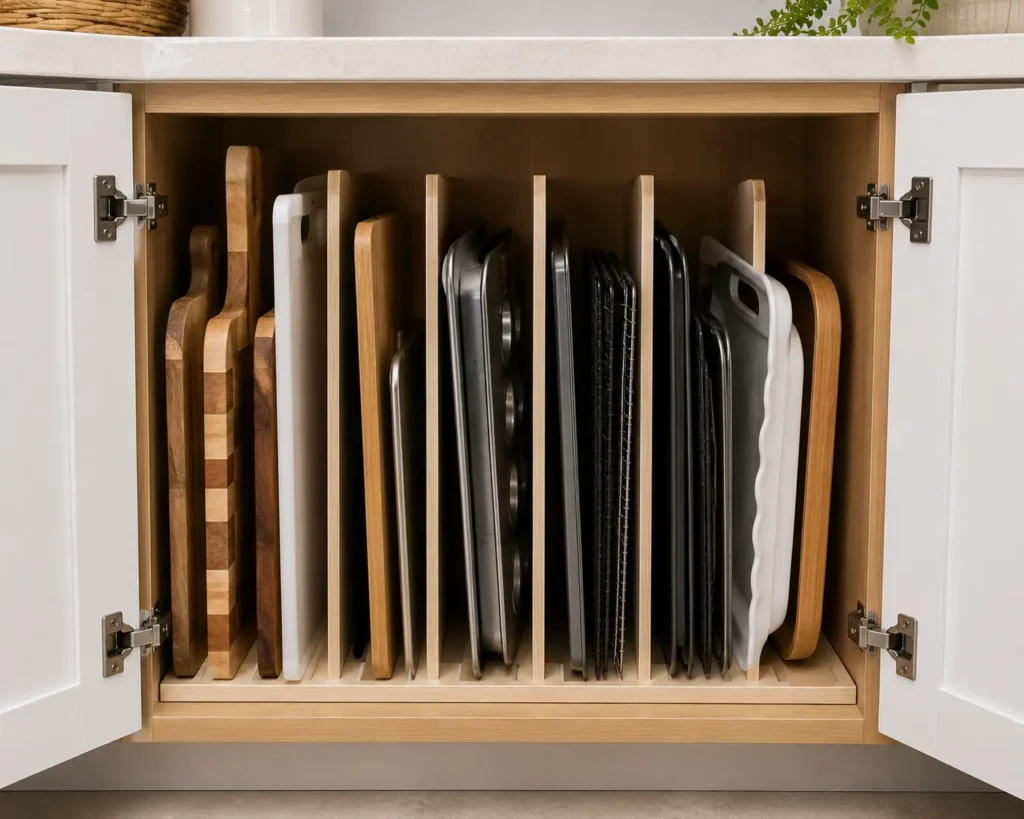
Idea 4 – Vertical Dividers for Trays, Cutting Boards, and Baking Sheets
One common mistake is stacking flat items horizontally. Every time you need the item at the bottom, you have to move everything on top of it.
Vertical dividers solve that problem by turning unused height into storage.
Use this approach for:
- Cutting boards
- Baking sheets
- Serving trays
- Cooling racks
- Large lids
Arrange them vertically so each item can be lifted out individually.
This is one of the easiest corner cabinet storage ideas because it uses vertical space without requiring major changes to the cabinet.
Idea 5 – Two-Tier or Stackable Shelves
When a corner cabinet has a lot of vertical space but only one shelf, you may be using only part of its capacity.
Adding a second level allows you to separate categories and see more items at once. Small bowls, containers, mugs, and kitchen accessories can often benefit from this setup.
The important thing is to avoid creating a second hidden pile. Keep heavier or taller items on the lower level and smaller, lighter items above.
A simple two-tier arrangement can turn one crowded shelf into two easy-to-use zones.
Idea 6 – Door-Mounted Storage for Blind Corners
The cabinet door is often overlooked when thinking about how to use corner cabinet space.
For suitable blind-corner setups, the inside of the door can provide useful storage for lightweight items such as kitchen cloths, measuring tools, small brushes, or other compact accessories.
The key is to check the door clearance first. Anything mounted on the door should not interfere with shelves, hinges, or the cabinet opening.
Door-mounted storage is most effective when it handles small items that would otherwise clutter the main shelf.
Corner Cabinet Ideas for Small Kitchens
Small kitchens benefit from corner storage more than almost any other layout. When every cabinet matters, even awkward areas can contribute valuable storage.
You also do not need expensive modifications to improve the space.
Here are a few budget-friendly, no-installation corner cabinet ideas for small kitchens:
Use containers inside the cabinet. Group loose items into simple bins so they do not spread across the entire shelf.
Create zones. Give each part of the cabinet a specific purpose, such as cookware, serving dishes, baking tools, or pantry overflow.
Stack only when it helps. If stacking makes the bottom item difficult to reach, it is usually not worth the extra storage.
Use the back strategically. Place rarely used items in the deepest section and everyday items near the opening.
Measure before adding organizers. A storage solution that is too wide or too tall can make an already awkward cabinet even harder to use.
For renters or anyone who does not want to install hardware, simple shelf risers, removable bins, vertical dividers, and rotating trays can create a noticeable improvement.
Mistakes to Avoid When Organizing a Corner Cabinet
A corner cabinet can look organized on day one and become chaotic again a few weeks later. Usually, the problem is not a lack of storage—it is a system that is too difficult to maintain.
Avoid these common mistakes:
- Stuffing the cabinet completely full: Empty space around frequently used items makes access much easier.
- Putting everyday items in the back: The hardest-to-reach areas should usually hold things you rarely need.
- Mixing unrelated categories: Pots, containers, baking tools, and serving dishes should not become one giant pile.
- Ignoring vertical space: A single shelf may leave half the cabinet’s height unused.
- Choosing storage without measuring: Always check width, depth, height, shelf clearance, and door movement.
- Creating hidden stacks: If you cannot see an item, you are more likely to forget about it.
- Keeping items you never use: Organizing is also a chance to remove duplicates and things that no longer serve a purpose.
One of the most important rules for organizing awkward kitchen corners is to prioritize access over maximum capacity. A cabinet that holds fewer things but lets you reach everything easily is far more useful than a cabinet packed from floor to ceiling.
A Simple Way to Keep Your Corner Cabinet Organized
Once your cabinet is organized, maintenance should be simple.
Every few months, pull everything out and quickly review what is inside. Return items to their assigned zones, remove anything that has migrated into the wrong section, and check whether you are still using the current layout.
Your storage needs can change over time. What works after a kitchen cleanup may need to be adjusted after you add new cookware, change your cooking habits, or start using the cabinet differently.
The goal is not a picture-perfect cabinet. The goal is a cabinet where you can reach what you need without moving ten other things first.
Final Takeaway
The best corner cabinet organization ideas focus on accessibility, visibility, and making awkward space work for your everyday routine. Rotating shelves, pull-out systems, vertical dividers, stackable storage, and smart placement can all help depending on your cabinet type.
Start by identifying whether you have a blind corner or a rotating-style cabinet, then organize the space around what you actually use. Once every section has a purpose, that frustrating kitchen corner can become one of the most useful storage areas in the room.
For more practical ideas, continue exploring Dailyrecs Hub with related guides on how to organize kitchen cabinets, how to organize a small closet, and other simple home organization solutions.
Internal Linking Opportunities
As you continue upgrading your kitchen, you may also find these helpful:
- Induction vs Gas vs Microwave Cooking: Which Is Best for Your Kitchen?
- How to Make Your Kitchen More Energy Efficient
- 10 Easy Ways to Organize Your Kitchen Without Buying Anything New
Love simple home maintenance tips like these? Join the Dailyrecshub community on Pinterest, for daily home & kitchen inspiration, appliance c